James Mackie, a lecturer on the animal management degrees at Merrist Wood, talks about being a zoo keeper, making his classes a safe space for discussion, and being animal-focused no matter what.
Being animal people together: Q+A with lecturer James Mackie
Tell us about yourself.
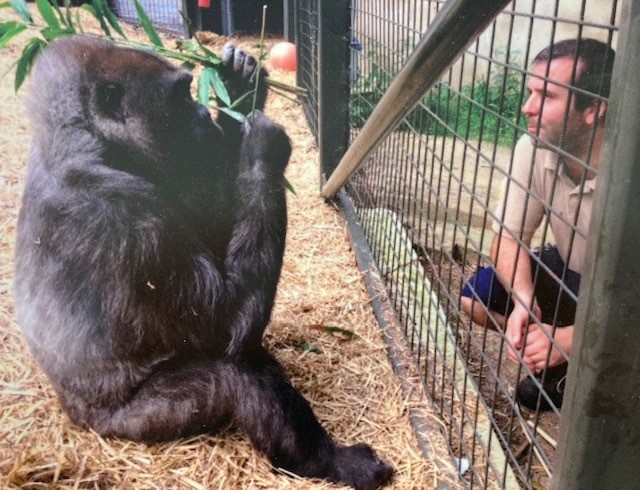
I was a zoo keeper for 12 years before coming to Merrist Wood. I worked with all sorts of animals – sea lions, big cats, monkeys – but mostly with gorillas. I just fell in love with gorillas the first time I met them, and I worked closely with gorillas for a number of years. I first found out about Merrist Wood because I had a lot of work experience students coming to me when I was a zoo keeper – and it was the students from Merrist Wood who always stood out. I applied for a role to teach at Merrist Wood in 2013, and I’m glad I did. I love teaching, and I’m happy to play a role in training the next generation of zoo keepers. At Merrist Wood, I teach on modules including: Management of Zoo Collections, Animal Behaviour, Breeding Programmes & Husbandry, Animal & Human Interactions, and Behavioural Ecology.
What misconceptions do people have about animals?
People often think that animals love humans. But actually, the best way to treat an animal is to have as little impact on it as possible. Every interaction you have with an animal should be a health check – whether you’re stroking an animal or observing it. There should be a good reason for each interaction – and behaviour is how animals speak. I always remind students that animals in a captive environment haven’t chosen to be there, but they have chosen to go and work with them in that environment. You always have to be very animal focused, and make sure all welfare inputs are positive for the animal.
What’s your teaching style?
I see students as being my customers – they need information, learning experiences, and to enjoy what they’re doing. I try to bring that into everything I do. I treat students as equals, and we try to have a bit of banter along the way. I’m open and honest with students about absolutely everything. Sometimes I’m a bit provocative to get some healthy discussion going. Working with animals isn’t necessarily what you’ve seen on social media, and it’s important they understand the reality. The foundation of everything they learn is to be as gentle around the animal as possible, non-invasive, and genuinely animal-focused. I also teach a lot through real-life experiences. We visit zoos and critique them, and have open and honest interactions the whole time.
How do you use the Animal Management Centre at Merrist Wood?
It’s a great resource. We’ve got a wide range of animals in there, and students learn from everything we do with them – and share their ideas too. For example, we took in some pygmy marmosets a few years ago, and they hadn’t bred since they arrived. We moved them to a different enclosure with more space, more privacy and more behavioural freedom, and now they are breeding. There are plenty of ongoing learning opportunities like this students are involved in – and they’re gathering data using GoPro cameras, and recording health and welfare indicators. Then we can put steps in place to further improve the welfare of any animal in our care.
What other skills and knowledge do students need to have a career working with animals?
Animals don’t care about qualifications, they care about interactions. So the number one thing students must learn is to be animal-focused at all times. Getting qualifications and experience is vital to get a job. Some people want to work with animals because they prefer them to people! But you must also be able to stand up and talk to people, so we practice that in our classes too. It’s a safe space to develop confidence. As soon as students tap their keycards and come into the building, it’s their world. It’s inclusive. No question is stupid. And any topic relating to animals is there to be discussed.
You’ve been teaching at Merrist Wood for more than 10 years – what jobs have some of your students gone on to do?
Our students are spread far and wide. We have a lot of graduates working at zoos, children’s farms, sanctuaries and reserves – all over the world. But there are a lot of other interesting jobs too. Some are at The Pirbright Institute, which does a lot of research into diseases in animals. We have former students at the Animal Reception Centre at Heathrow Airport. This is really important – there’s a lot of illegal trade in animals, and people try to smuggle animals through saying they’re different species when they’re actually rare and protected species. Being able to identify species is crucial for roles like this. Some students go onto work in farming. One former student works for Flooglebinder, which runs international sustainability trips for school and college students. A lot of people come back to work at Merrist Wood too!
What’s the community like in animal management at Merrist Wood?
The team we’ve got here really gets animals – we’re all animal people. Everything we do is in the animal’s best interest, and it’s great to get this ethos across to our students. Students come to us from all sorts of backgrounds, dealing with different things – which could be neurodiversity, having experienced a tough time at school, carrying baggage from their lives. But when they join us, it’s a community they become part of. It’s inclusive, people get to know each other, support each other and form close bonds. The students are only supposed to be here two days a week because of the consolidated timetable, but many of them are in more often than that because they want to hang out and study together. So I think we must be doing something right!