
Katie Hogan, a lecturer on the animal management degrees at Merrist Wood, talks about being a zoo keeper, debating animal ethics, and her experiences of Merrist Wood as a former student and as part of the teaching team.
Everyone can make their impact: Q+A with lecturer Katie Hogan
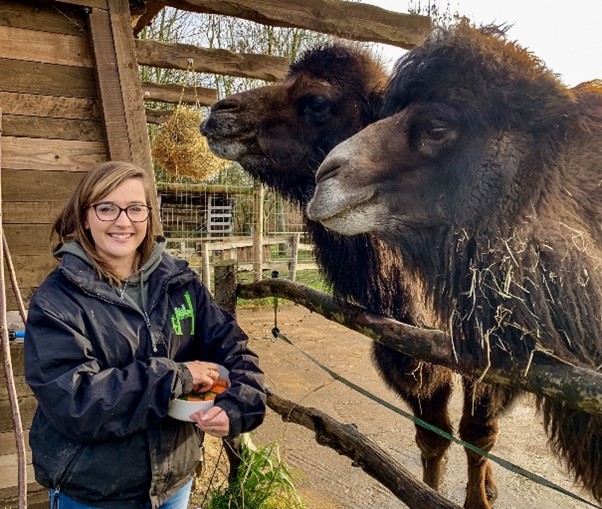
Tell us about yourself.
I actually did my undergraduate degree at Merrist Wood, so I’ve come full circle now I’m a lecturer here too! I did the previous version of the Wildlife and Conservation foundation degree, and for my third year, I did the Animal Behaviour and Welfare top up, graduating in 2015. I always knew I wanted to go into education, but I wanted to work with animals for a while first. When I was studying at Merrist Wood, all my lecturers had so much experience they could talk about in the classes, and that’s what made it really interesting and engaging – so I wanted to eventually be like them! I was lucky to get a job as a full time zoo keeper at Hobbledown after I graduated, which I did for four years, and then worked my way up to be a zoo curator and education manager for another four years. I’ve recently gained my PGCert in Conservation and Sustainability Education, and I’ll be starting my Master’s soon. At Merrist Wood I teach on modules including Health, Welfare and Nutrition, Ethics, and Practical Projects.
What was your experience as a zoo keeper like?
I really wanted to focus on animal welfare and improving the zoo, and that’s exactly what I was able to do. The zoo was quite new when I first started, so it was a good opportunity for me to put my own stamp in it. And I also got to build a new one in Hounslow while I was there, which was really cool. Through my time there, I gained experience of both sides of the zoo world – the practical zoo keeping side, and also the management, enclosure design and the licensing. All the boring stuff, which is actually super interesting to me!
Your teaching focus at Merrist Wood is welfare and ethics. How do students learn about this?
Welfare and ethics encompass every part of the animal industry, so these topics really prepare students for their future jobs. We discuss, debate and critique a lot – looking at different aspects of the industry – and ask questions about the ethics, the good parts, the elements that need improving, and how we can establish quality of life for animals. We consider different scenarios and ask: ‘just because we can, should we?’ and ‘is this right for the animal?’ We ask these questions in the field too. For example, on our trip to South Africa, we explored whether the understanding we gained of wild animals could enhance the welfare of captive animals. We went out and did assessments to understand animals’ needs, and whether they were being met or not. I’m really keen for students to form their own opinions, which is important in the animal industry, because it means you can go into a job with new ideas too.
What skills do students learn at Merrist Wood that they can apply to their future jobs?
So much of what we do on the course is super transferable. Students build their critical thinking skills and confidence to form their own ideas. Students practice welfare assessments a lot – and these are used throughout the industry. If they go on to work in a zoo, welfare assessments are part of the day-to-day role, and doing them helps zoo keepers to be proactive with solutions. If students go into lab research, having this complex knowledge of welfare, ethics and the related legislation informs everything they will do. And if students go onto work with companion animals or animal health – thinking about what is right and wrong for the animal is everything.
How much practical experience do higher education students get at Merrist Wood?
It’s woven into almost every aspect of the course. We go on field trips – including optional international field trips – where they can put their knowledge into practice. This helps give them the variety and complexity of skills they need to work in the industry and beyond. Students are also given time to do work experience during their studies, and the networks we all have as lecturers at Merrist Wood mean we can often help connect students with industry contacts. We also task students to reflect on their work experience afterwards, thinking about their strengths, weaknesses, and what they need to work on that would make them more successful in the industry. It could be anything – public speaking, computer skills, practical experience with a certain animal. This helps them get the very most out of their time with us.
Students can’t stop talking about their latest trip to South Africa. What was it like?
None of the students wanted to go home – it was incredibly difficult to get them on that plane! They had such a great time and were blown away by the opportunities they had. We did 14 different types of ecological surveys – which is a lot to fit into a 12 day trip. We visited the Born Free Foundation Centre and discussed the differences between reserves, zoos and sanctuaries, and the welfare implications of those differences. We did some conservation work with the vulture project VulPro, and learned about how they run release programmes. And we also did some community days, so the students could understand more about conservation engagement, and how this work is about more than animals.
What if students don’t know what career they want to do yet?
That’s all part of the process! As teaching staff we all have quite different experiences, and this can help if students want to sit down and brainstorm ideas. We’ll discuss what they’re interested in, what they have a natural flair for, and suggest different industries or jobs that might be a good fit. Sometimes there are jobs they never knew existed! We’re here to open their minds to the niche areas that would make their skillsets thrive. I think that’s something that sets us apart at Merrist Wood. We will always give that time and support to students to develop their passions and find the right career for them.
Why is now a good time to pursue a career in animal management or a related field?
It’s well-known that the world isn’t in its best condition right now. So why wait until tomorrow? We have these degrees on offer now where students can learn everything they need to make their impact while they still can. We have the tools to educate about wildlife and conservation. We have the tools to enhance animal welfare. Protecting wildlife is also about protecting their environment. We need people with this breadth of knowledge that encompasses sustainability and green skills too, who can make a difference. Even if our graduates go off to work in a completely different industry, they will still take that core knowledge with them, which will set up other industries to contribute to conservation too.
How do you describe the feeling of being at Merrist Wood?
It’s special. There’s a real feeling of community, and students know they can just knock on the office door, or email us anytime. Being in a small group of students is a very different feeling to being one of hundreds of students at a bigger university. Everybody is passionate about animals, and when you’ve got that one specific thing that everybody’s interested in, you instantly become a big, happy community.