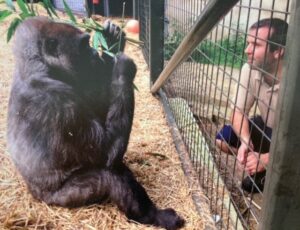
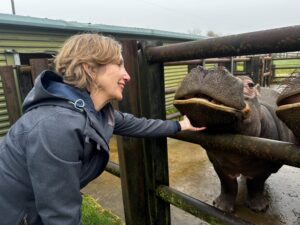
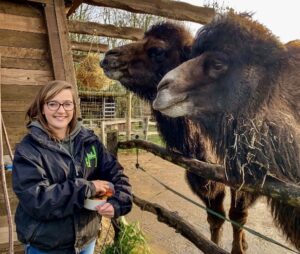
Jack Merrifield, Animal Management Faculty Manager at Merrist Wood, talks about the value of embarking on a higher education course in animal management, championing animals that don’t get the limelight, and understanding those weird things animals do…
For the love of animals: Q+A with faculty manager Jack Merrifield
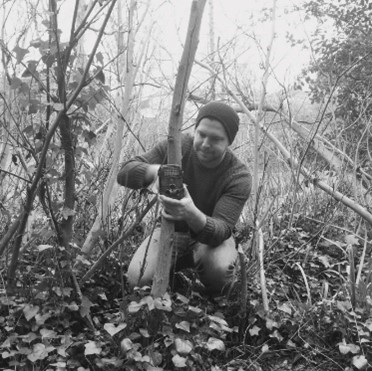
Tell us about yourself, and how you landed at Merrist Wood.
I love dogs and horses, I used to teach veterinary physiotherapy, and my specialisms are in predator-prey dynamics and animal cognition. I have a research partnership with Shamwari Private Game Reserve (in South Africa, and we’ve recently set up a new one with Lao Conservation Trust for Wildlife too. I sit on the Board of Strategic Directors for an animal welfare charity in New York called the Zoological Lighting Institute.” I previously worked at Southampton University and Berkshire College of Agriculture, before joining Merrist Wood. Activate Learning is pretty much the biggest educational provider in the south east – it’s got a strong pull. They’re so enterprising and innovative in what they do – I wanted to be a part of it. At Merrist Wood I teach on modules including: Conservation of Global Biodiversity, Native British Wildlife, Practical Experiments in Animal Behaviour, Animal Cognition, Creating Sustainable Futures, Conservation Technologies & Science Communication, and the Dissertation Research Project.
Set the scene. What is the Merrist Wood campus really like?
It’s a beautiful location. It’s a 400-acre estate in the Surrey countryside, perfectly positioned between Guildford and London. We’ve got everything from mixed leaf woodland to arable farmland. It’s a place steeped in history, and it’s always been very passionate about education. We attract students from all over the place – locally, across the UK and even internationally – and we have a range of study programmes that really appeal to students from all walks of life. It’s a place where people are willing to put themselves out there, try new things, and be innovative. That’s something I love about this place.
What’s the feeling like when you walk through the door at the Animal Management Higher Education Centre?
It’s a community, and we know each other by name. We really get to know our students, and they get to know us. We deliberately keep class sizes small to create a strong rapport between lecturers and students. That also means we’re able to provide bespoke support to each student depending on their needs, to help each individual thrive. The feedback we get from students is that they value the support they get, and they’re really engaged by the passion that comes through from the lecturing team. Many of our team actually studied here, left to work in industry, and have returned to teach. You don’t find that in many places. I think that speaks volumes about the pull of Merrist Wood. It’s special.
What’s your ethos on teaching and learning?
As a student, you’re here not just to learn, but to grow, think, try new things and be as creative as you want to be. That ties in with the Learning Philosophy developed by Activate Learning, which is award-winning. It’s part of our culture. Through teaching, we help students create meaningful associations with the topics, which helps them learn and understand themselves as individuals better. Students really connect with that, and many study with us from Level 1 through to Level 6. Even if they take a break to work in industry for a while, many come back to us. It shows we’re at the forefront of their minds when they want to add to their knowledge base.
Why is animal management an important topic of study?
Animals need us to be a voice for them, and we need animals for the sake of the planet. We study all animals here, but we’re especially focused on the animals that don’t get the limelight, as they often form the basis of the food chain. In our project with Lao Conservation Trust for Wildlife alone, we’re looking at species including pangolins, sun bears, hog deer and elongated tortoises. Some people have never heard of these species, but they are endangered species and essential for the ecosystem. Animals are hugely important indicators for the environment.
How should students choose between the three animal management higher education pathways: animal behaviour and welfare, zoo management, and wildlife conservation?
The animal behaviour and welfare course keeps a lot of doors open for students, so it’s good for those still exploring which direction they want to go in the animal industry. It also incorporates emerging subjects such as animal cognition, which is going to be the next big thing. Zoo management focuses on captives, exotics, domestics and livestock, and it’s good for people who want to work in rescue sanctuaries, zoos or game reserves. Wildlife and conservation attracts a lot of people who love outdoorsy things – who are interested in future careers as ecologists, conservationists or generally working in the environmental sector – which again is huge, and growing.
Will students be able to make a difference to the planet?
A lot of students join us because they want to be a positive influence on the world. And we link all the degree pathways strongly to sustainability. This is such a fast-growing sector, and so many job roles have a sustainability element to them. So students develop green skills and transferable sustainability skills. Our focus is on bringing together academic rigour with developing a skillset that is practical, relevant and addresses industry needs.
How hands-on do students get on a Merrist Wood animal management course?
We try to get out of the classroom as much as possible. It’s all about how you apply your knowledge and skills – and students need time with animals for that. We have an animal activities license to make that happen, and our Animal Management Centre is incredible. We also visit a lot of other locations, including local green spaces and zoos, and we offer students the opportunity to go on trips abroad – the last one was to South Africa. Students are encouraged to take work placements and get out into industry – developing skills to complement the degree and work towards their specific goals.
Aside from placements, can students interact with the animal industry through the course?
We have a lot of connections with industry that students benefit from. First off, all our lecturers have so much experience in industry, and they share their experiences with students in every lecture. We have experts and people working in different fields coming in to deliver talks and workshops to the students. We’re really well connected to the local community, so there are opportunities for students to connect with local animal and conservation organisations too. We also deliver training to organisations – for example, we trained Surrey Fire and Rescue recently on how to handle escaped horses. Students are exposed to everything we’re involved with at Merrist Wood, which gives them valuable experiences and ideas to inform their futures.
What about international connections?
We’re lucky to have some strong international organisations we collaborate with. One of them is Shamwari Private Game Reserve in South Africa, where we took students on a visit this year. We also won some funding to send equipment to Lao Conservation Trust for Wildlife in Southeast Asia. Now the organisation is sending data back to us captured from the equipment we sent, and students are actively analysing that data. We currently have one pair of Level 5 students analysing data on critically endangered Siamese crocodile behaviour in captivity. These are reptiles we know virtually nothing about in captivity, yet they’re popular exotic pets and part of the illegal pet trade. That’s just one of many examples. Our students are doing novel, real world research that international organisations rely on to inform their husbandry practices. And students are raising awareness about essential endangered species at the same time.
How much time do higher education students spend at Merrist Wood?
We have adopted a consolidated timetable here, so students only need to be in for two days a week. That gives students the rest of their week to earn while they learn if they want to, or use our facilities for independent study. We’re still here on the other days if they need us. We have a dedicated higher education centre for animal management students, and we often see a lot of students here even on days they don’t have lectures. They’ll come in to do work with the animals, work on their dissertations, or just study alongside their peers. They can come and go and master their own learning.
Working with animals is a hands-on field. Do you use any technology too?
Activate Learning has won a lot of awards for the use of digital technologies in teaching, and as an organisation we’ve created our own AI models that staff and students can use. AI can be really useful in animal management, especially as a non-invasive monitoring tool. For example, it can be difficult to tell individual animals apart, but AI is very good at identifying individual animals with a high level of accuracy. AI can also characterise animal sounds, meaning you don’t have to catch animals. So it’s a stress-free way of monitoring welfare and conservation.
What drives students to embark on an animal management course?
There’s always a moment a student had with animals that made them go “oh!” It might have been their dog doing something weird. It may have been something David Attenborough said. That “weird” moment is usually the starting point for a student to embark on their learning journey with us. They may not have acknowledged it, or been asked the question before, but there’s always something there. Not only does that motivate them to study one of our courses – it usually ends up being what they base their dissertation on, and it often becomes part of their career too!
If there’s one thing students get from an animal management course at Merrist Wood, what is it?
It’s how to be a voice for animals. The animal industry is a people industry with animals in it. Animals can’t tell us what they think and how they feel a lot of the time. But cognition and behaviour is a proxy for that. So if we can start to understand their behaviours and thoughts, we can be a voice for them. We believe in enriching student lives by enriching animal lives.