
As a lecturer on the animal management degrees at Merrist Wood, Jen Law talks about why there’s a growing need for conservation and ecology skills, helping students realise their potential, and getting out in nature on the Merrist Wood estate.
Being the ecology person: Q+A with lecturer Jen Law
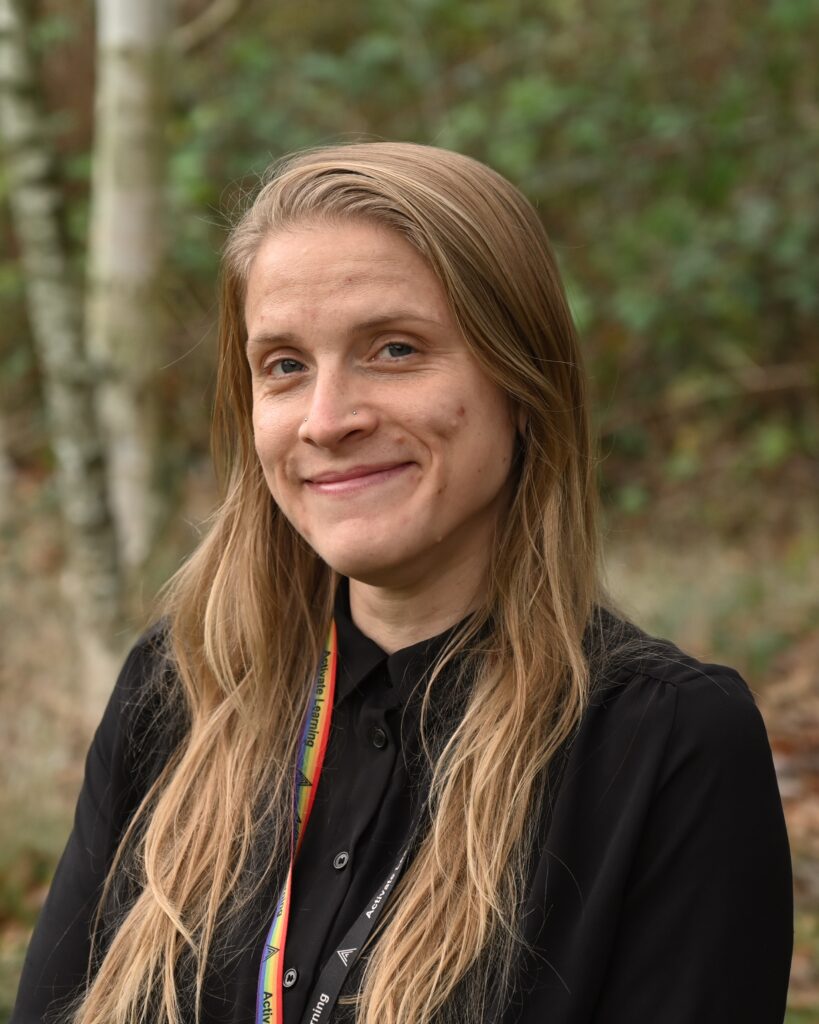
Tell us about yourself.
Anything to do with ecology and wildlife conservation is my thing – I’m very much the ecology person at Merrist Wood! I’ve got a degree in Environmental Science and a Master’s in Ecology and Evolutionary Biology. I’ve worked for a whole range of charities, including London Wildlife Trust, Groundwork and BirdLife Malta, and I also used to run school trips in Alice Holt Forest. At Merrist Wood I teach on modules including: Development of Personal & Professional Skills, Fundamentals of Ecology and Ecological Field Skills and Native British Wildlife.
What does being “the ecology person” involve?
My area of expertise is the habitats that different animals live in, the conservation of those habitats, and wild nature. Bees is my specialist subject – any of my students will say I talk about bees way too much! I teach ecological field skills, which are practical things like how to conduct surveys, how to observe wildlife, and how to develop a management plan for a site. Sustainability is a big topic, and through my teaching we talk about how to make the world more sustainable, and what actions are needed to achieve sustainability goals. I also teach students how to use conservation technology, which includes camera traps, drones, artificial intelligence (AI), Global Positioning System (GPS) and Geographic Information System (GIS) mapping.
Tell us about the Merrist Wood location.
Merrist Wood is a big estate, and it’s very special. Its size means we get to do a lot more practical work than other university courses with smaller or city-based campuses. We can leave the classroom and go into the woodland, our wetlands, or observe some farm animals. We’ve got a huge range of really important habitats on campus, and we’ve even got some rare and threatened species.
What do students say about their experiences at Merrist Wood?
Many of our students are just really excited by nature and wildlife. They love all the practical work we get to do. They love putting on waders and going in a river, or catching little rodents and things like that! Students also express how they feel very supported by our team. They like the fact they learn in much smaller groups compared to other universities, and how they get a lot of attention and support. They can also drop into the office and see us anytime, which they say they like.
What skills do students learn from your modules that they can apply in their future jobs?
Students gain all the skills they need to go off and work in conservation management for conservation charities, or to become park rangers for wildlife trusts – and we have a lot of graduates going off to do jobs like that. Students are also able to go into any kind of job in ecology with the ability to do ecological surveys and species surveys. In our recent sessions we’ve been talking a lot about how there is quite a lot of new legislation in the UK, for example the biodiversity net gain (BNG) legislation. So for any new major construction project, like building new housing, there’s a legal requirement to improve the biodiversity. This means there’s been a huge increase in the requirement for ecologists and people who can do ecological surveys.
How do students figure out what kind of job they want to do?
Some students have very clear career aspirations, or they may know they want to work with a particular species or for a certain organisation. We help them shape their learning and practical experiences to get them where they want to be. But there are a lot of students who come to us and they’re not sure yet. They know they don’t want to be in an office, they love the outdoors, and they’re passionate about making positive change in our world. So we support them on their journey to finding a career destination. We also host guest talks from people who work in the industry to explain their jobs, what they do and how they got into them. We’ve had people from Surrey Wildlife Trust, Thomson Environmental Consultants, a dog trainer, and more. That – together with work experience – can really help students find their career paths.
What kind of work experience should students do?
Studying is essential to get to know the concepts and theories behind everything. But to get a job in the field, you need practical experience – which you will get through the course, volunteering and work experience. There are lots of opportunities out there. We have a huge database of contacts at Merrist Wood, so students just have to ask us for a steer or some help. Surrey Bat Group always need volunteers for bat surveys, and Surrey Wildlife Trust regularly have opportunities for volunteers on their nature reserves. Work experience will help students pinpoint what exactly it is they enjoy. People come back from work experience either liking or disliking what they’ve done – both types of experiences are invaluable. I always advise students: get to know your species, get to know your surveys, and get to know people.
Is there any feedback you’ve had from a student that stands out in your mind?
We had one student who transferred over to Merrist Wood from another university, where she’d been struggling. We give a lot of extra support to students at Merrist Wood – and once we’d helped this student through some of the difficulties she was having – she said: “I’m actually good at this. I’ve never done this well at anything before.” It’s amazing what kind of impact a bit of bespoke support can have.
How does Merrist Wood help you pursue your passions?
Our team is really small and passionate, which is great to be a part of, and I think that comes through in our teaching. None of us have just stayed in academia forever – we’ve all done practical things in the field, worked in different organisations, countries and contexts. We’re all very excited about what we do. And I love working in a place where I’m surrounded by all this nature and wildlife. Some of us bring our dogs in too. Students drop in at lunchtime to say “hi” – they pretend they’re interested in us, but they really just want to see my dog!