
The BA (Hons) Furniture Design and Make is designed to prepare students for a career as furniture designers and makers and recognises the need for an interdisciplinary approach to help maximise future employment potential. The programme provides an opportunity to acquire the knowledge, skills and understanding of what it means to work within furniture-related organisations and encourages students to develop interest in specific learning opportunities.
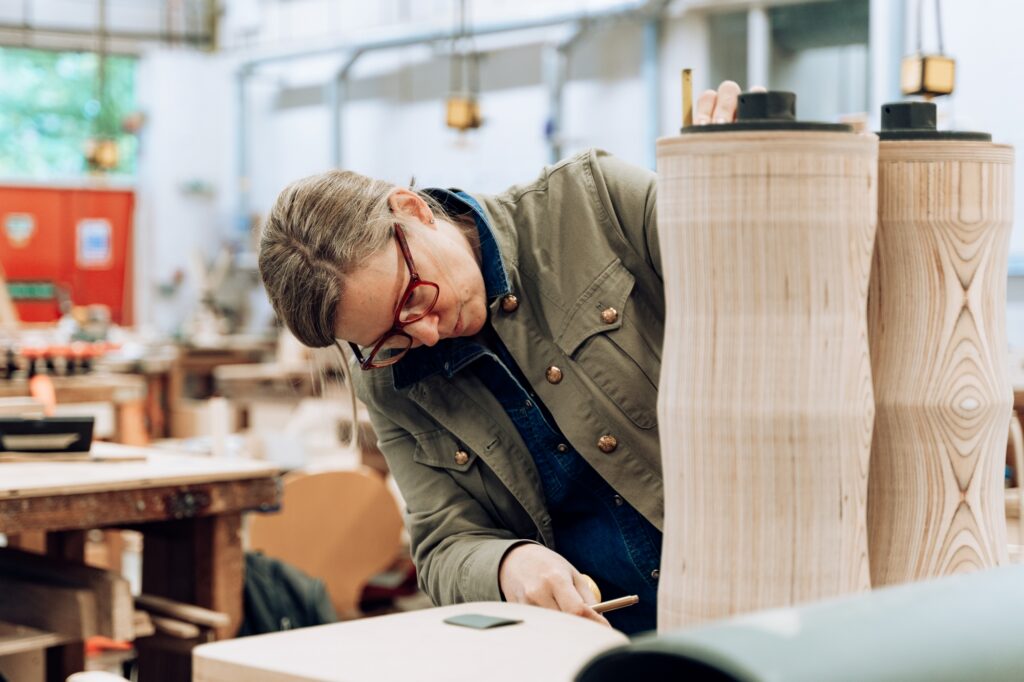
BA (Hons) Furniture Design and Make
Furniture

Course Details
Study Mode
Full/Part Time
Start
13/09/27
End
09/06/30
Day of week
TBD
Duration
3 Years
Guided Learning Hours
450 hours per year
Self Study Hours
750 hours per year
Fees
£8,400 per year
Home/EU students.
International students not accepted.
The BA (Hons) Furniture Design and Make is designed to prepare students for a career as furniture designers and makers and recognises the need for an inter-disciplinary approach to help maximise future employment potential. The programme provides an opportunity to acquire the knowledge, skills and understanding of what it means to work within furniture related organisations and encourages students to develop interest in specific learning opportunities.
Learning is supported through close contact with a range of furniture specialist tutors with access to dedicated facilities and provides an opportunity for personally- focused learning.
Students will develop critical thinking and practical skills, as well as professional and research skills. Alongside the academic study in the programme students will develop the communication skills that will equip them to respond to changing conditions, to develop an ability to work in different environments and to seek out diverse opportunities within the furniture industries.

Year 1 (Level 4) Modules
Technical & Visual Communication (30 Credits)
The aim of this module is to introduce and explore the means by which designer-makers explore and develop their ideas and communicate these with other professionals.
The module focuses on freehand drawing, rendering, visual research, technical drawing and CAD as tools for creativity and technical development.
Introduction to Wood Machining (15 Credits)
The aim of this module is to introduce and develop the machine skills for making furniture. Practical exercises will focus on relevant woodworking skills, wood machining, health and safety and problem solving. Students will make a stool accurately following technical drawings.
Introduction to Cabinet making (15 Credits)
The aim of this module is to build on the student’s previous experiences to further develop the machine and hand skills for making furniture. Practical exercises will focus on relevant woodworking skills, wood machining, health and safety and problem solving. Students will make a carcase piece of furniture accurately following technical drawings.
Design and Make (30 Credits)
The aim of this module is to introduce and combine the essential skills of a furniture designer and maker. It provides an introduction to the design process when students will be able to undertake design and make projects which require them to utilise design process methodologies to research, generate and explore ideas, develop, define a creative design outcome and realise to a high level of craftsmanship.
Timber Technology (15 Credits)
The aim of this module is to provide an introduction to the contextual framework that the outcomes of a furniture design-maker will occupy. It will focus on technical knowledge of furniture making.
Furniture in context (15 Credits)
The aim of this module is to provide an introduction to the contextual framework that the outcomes of a furniture design-maker will occupy. It will focus on material culture.
Year 2 (Level 5) Modules
Advanced Technical and Visual Communication (30 Credits)
Furniture Production (30 Credits)
The aim of this module is to develop students’ professional practice in furniture making. Projects focus on an understanding of expectations in commercial workplaces, an appreciation of quality standards, batch production techniques and production planning. The projects are work related and furniture produced will be retailed through a gallery/shop/exhibition.
Advanced Design and Make (30 Credits)
The aim of this module is to provide opportunities for students to develop their ability to use the design process as an effective tool for decision making and for the progressive initiation, exploration, development and definition of creative design solutions. Students are expected to demonstrate continuous improvement in their craft skills producing work to a refined finish.
Social Implications of Design (15 Credits)
The aim of this module is to extend the student’s knowledge and understanding of materials and manufacturing methods, their selection and application for the manufacture of artefacts. It will focus on a specific area of craft/manufacturing with links to social implications of design and sustainability
Furniture Culture and Society (15 Credits)
The aim of this module is to extend and develop a knowledge and understanding and appreciation of material culture. The student will consider key design issues of craft, sustainability, active citizenship, digital technology, production and industrial context, as well as the construction of meaning and cultural identity.
Year 3 (Level 6) Modules
Professional Design and Make (30 Credits)
The aim of this module is to respond to a live design brief set by an external organisation. The module is industry linked and will provide external feedback during and at the culmination of the project. Students will be expected to aspire to the Worshipful Company of Furniture Makers (WCFM) ‘bespoke guildmark’ criteria of excellence in design, craftsmanship, function and materials.
Professional Development and Portfolio (15 Credits)
The aim of this module is to develop professional skills to meet the challenge of promoting core furniture design and making skills/abilities. This module is linked to industry, and students will consider self/product promotion and business planning. The project will require the students to participate in a live design and make a brief that will culminate in a selling opportunity to the public.
Personal Project: Written (30 Credits)
The aim of this module is to independently undertake a small-scale research project. The written project offers the opportunity to develop a sustained, rigorous piece of contextualising work. The conclusions of which will be used to establish a design brief and a range of project proposals that will ultimately provide direction for the Major Project: Design and Make.
Major Project: Design and Make (45 Credits)
The aim of this module is to apply creative and technical design and craft skills in response to a personal project brief. This module brings together all of the professional practice, contextual understanding, furniture design and craft skills/knowledge and experience to culminate in a major personal project output.
The BA (Hons) Furniture Design and Make programme provides opportunities for students to achieve the learning outcomes using a range of different learning experiences. Students continue to develop knowledge, skills and confidence in their capabilities throughout the programme. The module assessments have been designed to assist in the building of skills offering formative feedback before summative assignments. There will be a schedule for each student that provides the opportunities to demonstrate their knowledge and skills. The module assignments will require students to demonstrate a thorough grasp of the knowledge which is essential in order to practice safely and develop competence.
Throughout the course a range of teaching and learning strategies are used. The strategies aim to help students think, reflect, evaluate and consider the impact of yourself and others in a broader context. Throughout the programme, teaching and learning strategies adopted by tutors will acknowledge and encourage a range of learning styles. The programme aims to provide a balance between provision of information and opportunities to assimilate actively, apply, question, debate and reflect critically
The module assessments have been designed to assist in the building of skills offering formative before summative assignments. There will be a schedule for each student that provides the opportunities to demonstrate their knowledge and skills. The module assignments prior to practice will require students to demonstrate a thorough grasp of the knowledge which is essential to practice safely and develop competence.
The assessments are designed to demonstrate attainment of the learning outcomes in line with the QAA subject benchmark statement for Art and Design 2026. Formative assessments and feedback will take place on a number of occasions throughout a modules’ duration. This can take place formally as written feed-forward (guidance as to how they would be able to improve their work on subsequent sections of the project or module) as well as orally in tutorials.
Summative assessments will take place at the end of each project within a module. Written feedback on this project will be given in relation to the student’s performance in overall terms and within the context of each assessment category. The context of the student’s performance across all module components in relation to the learning outcomes will also be summarised.
Tariff Points
64 points
Prior qualifications necessary for entry to the programme, including English language requirements.
Normally, the entry requirement would be a minimum of 48 UCAS points, comprised of either:
- a minimum of two A-levels at grade D
- BTEC Level 3 National Extended Diploma in Art and Design or;
- An Art Foundation course, or;
- Level 3 City and Guilds Diploma in Furniture, or;
- UAL Extended Diploma;
- Access to Art and Design,
In addition, applicants should have a GCSE grade C/4 or above in Mathematics and English Language (or a recognised equivalent vocationally related qualification).
Where applicable; IELTS normally minimum level 6.0 overall with a minimum of 6.0 in the reading and writing components and a minimum of 5.5 in the speaking and listening components.
Mature students
Activate Learning welcomes applications from mature students who may not meet our typical entry requirements, but who now wish to take the opportunity to develop their knowledge and practical skills. We are committed to supporting you throughout the application process and view our interview process as an opportunity to get to know applicants.
Normally the requirement would be:
Either:
- a minimum of the equivalent of two years’ full-time relevant work experience and a current role in an appropriate workplace setting
- evidence of ability to study at academic level 4
- evidence of support from their employer and recommendation;
Each application will be considered on an individual basis following the University principle of widening access to those who might not have the traditional academic entry criteria to degree level awards. All applicants to the course will be interviewed and their portfolios reviewed. This will enable the course team to assess the candidate’s suitability and compatibility to the course in a comprehensive way. It also allows flexibility in pre-requisite qualification requirements given the variety of entry points to the course. As a minimum, the portfolio interview should be able to demonstrate that the applicant can do the following:
- Show that they have an understanding of the course
- Demonstrate that they have the necessary (or required) academic, artistic and practical skills, as appropriate, to enable them to embark upon their chosen course of study
- Show that they are motivated to undertake the chosen course of study
- Show an awareness of, and interest in, creative ideas
Students are normally expected to start at Level 4, but can be admitted to any level of the course which is considered suitable, after portfolio review and interview using the Credit Accumulation and Transfer Scheme (CATS). Under this arrangement, a student may apply to have previous academic credits or other learning (APL) or experience (APEL) taken into consideration. Such applications are considered by the Faculty CATS committee and must be supported by the Programme Coordinator. For more information, please visit Credit transfer – Oxford Brookes University
The Degree in Furniture Design and Make will equip students with the theoretical understanding and the practical expertise needed to undertake work in a variety of roles within the field of furniture design and make. The course will emphasise the importance of understanding good business practice and thus widen their employability. The programme includes modules which cover a wide range of organisations and opportunities within the community. This aims to widen the students experience and give an insight into other organisations thus providing links for students who may wish to work in the community in roles linked to furniture design and make.
Graduates have found employment in a variety of roles within the furniture industry. Typically, they find employment as furniture makers, furniture designers/CAD technicians before moving into management positions and self-employment as designer-makers. There has been regular progression from the BA (Hons) into further academic study at Masters level supported by bursaries from the Worshipful Company of Furniture Makers (WCFM) or Queen Elizabeth Scholarship Trust (specifically at the RCA). Students have also progressed onto post graduate teacher training programmes.
An incubation unit providing supported graduate opportunities has been established through direct partnership with Sylva at their wood centre in south Oxfordshire.
|
Prior to Starting the Programme |
Cost |
|---|---|
|
Tools |
£250–£500 |
|
Drawing Equipment |
£40 |
|
Stationery/Sketchbooks |
£50 |
|
Personal Protective Equipment (PPE) |
£250–£500 |
|
Year |
Item |
Cost |
|---|---|---|
|
Year One |
Materials fee (consumables, toolbox, small table, jewellery box, small practical exercises and scale model) |
£300 |
|
Small table |
£50–£200 |
|
|
Year Two |
Materials fee (consumables, mirror, small box and bedside cabinet) |
£300 |
|
Chair |
£100–£200 |
|
|
Year Three |
Materials fee (consumables, lighting and small craft object) |
£200 |
|
Major Project |
£100–£200 |

IMPORTANT INFORMATION
Please read these important documents before applying for this course.